Nikolai Rostov Profile picture
proud chicken for kfc
Mar 9 16 tweets 11 min read
There are certain misconceptions about the Kowloon Walled City, the so-called anarchic and festering slum of British Hong Kong. Some include that housing quality and space was almost non-existent or that they were at least far inferior to less spontaneous public housing programmes; that poverty was significantly higher, that quality of life was far worse and that the area lacked governance (not to be equated with a state in this case). These are for the most part, misleading.Image Please note: although I'm pretty decent in Cantonese as it is one of my primary languages (我嘅廣東話一般般啦) I am mostly using Colonial-era Romanisation of certain location names. So don't take offence if you are one of the few people to be offended by that.

Feb 24 84 tweets 69 min read
Many people claim that the end of the Glided Age was a peak example of positive interventionism: big business doing whatever they wanted with little respite, which only stopped when government regulated and broke them up, freeing consumers from the yoke of unregulated capitalism. But is this true? The answer is... no. What if, instead... the regulations were done in the name of big businesses and special interests? This might seem difficult to fathom in the here-and-now, but read on.Image The following sections are mostly theoretical and provide for the reader a reason to believe the idea that regulation can be done for special interests, before actual empirical examples are given to bolster such an idea; if you are already well-versed in public choice theory, feel free to skip posts 3-8..)
Nov 10, 2025 15 tweets 14 min read
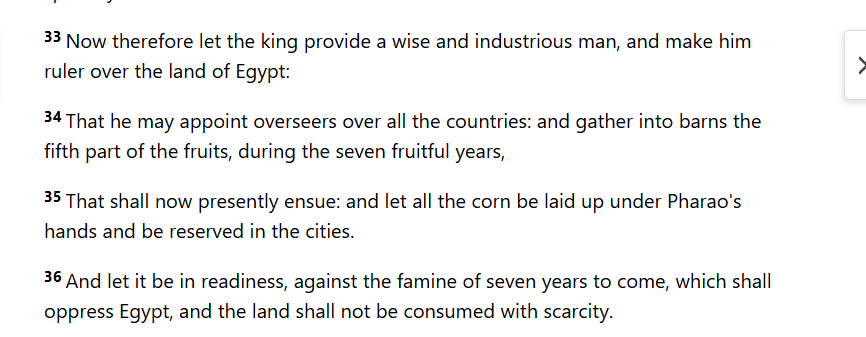
Today I will talk about historical price controls in several areas. Many people think price controls are a somewhat modern invention, as part of a spurn towards interventionism, but they are in fact very ancient. Since the dawn of time bureaucratic governments (There are several categories of "Statism", as David Gra*ber was kind enough to point out) have been interested in controlling foodstuffs, for everyone needs food and having supreme power in regulating it makes the statesman have disproportionate control over the citizenry.
Oct 31, 2025 27 tweets 29 min read
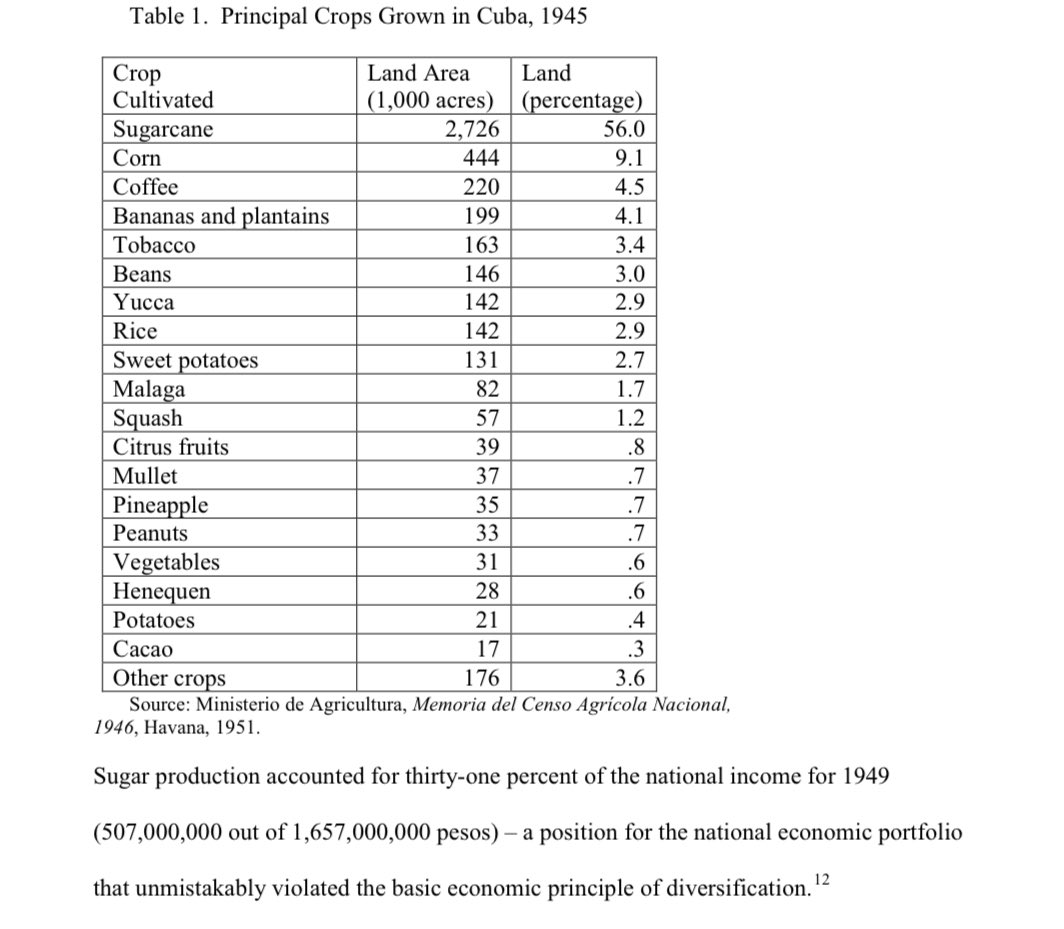
Today we will talk about the Cuban economy. It’s a very interesting case study on how central planning can have superficially positive aspects whilst being a hindrance to the general economy. We will first talk about Batista’s use of state planning before we talk about Castro’s, the special period and Cuba’s transition to a modern economy. Let us proceed. We first begin at around the 1920s-1950s, long before the Cuban Revolution. Si no hay azúcar, no hay cuba. That was a very common slogan repeated before Batista took power in 1952. As one can see, half of the total land in Cuba was dedicated to growing sugarcane.

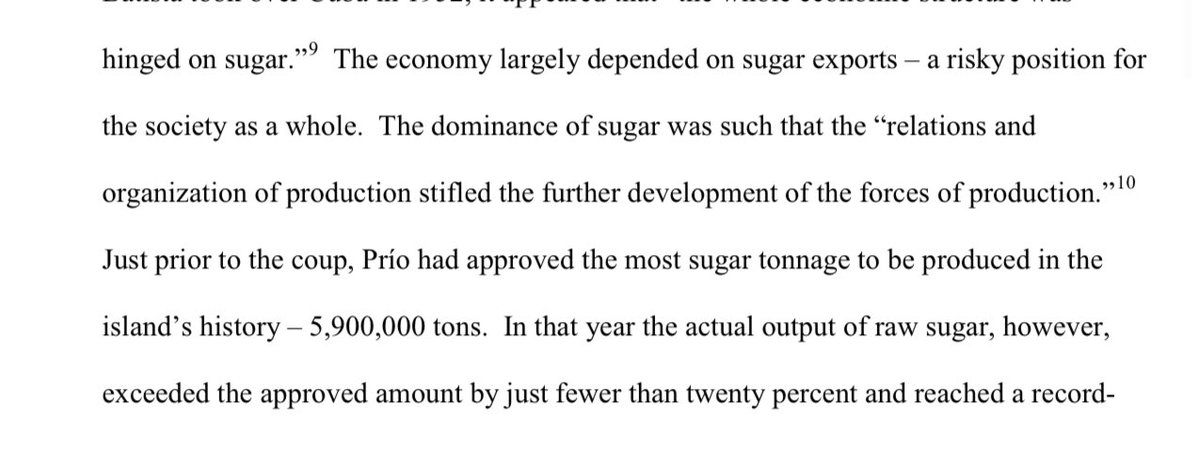
Prio had approved prior to Batista’s coup the production of 5,900,000 tonnes of sugarcane but the actual output exceeded the approved amount by 20%- 7,300,000 tonnes in total. Sugarcane accounted for 90% of Cuba’s exports and reached 31% of Cuban national income in 1949. It was in essence a “one-trick pony”, and an aging pony at that.Image
Image
Sep 5, 2025 23 tweets 23 min read
This is probably one of the most famous works in all of economics history. Amongst the same realm of Kapital, The Wealth of Nations, and General Theory. It paved the road for an entirely new field of research, and has almost 60,000 citations. But what does it argue? A 🧵Image Coase begins the paper very clearly: economists have failed to state and rationalise their assumptions.

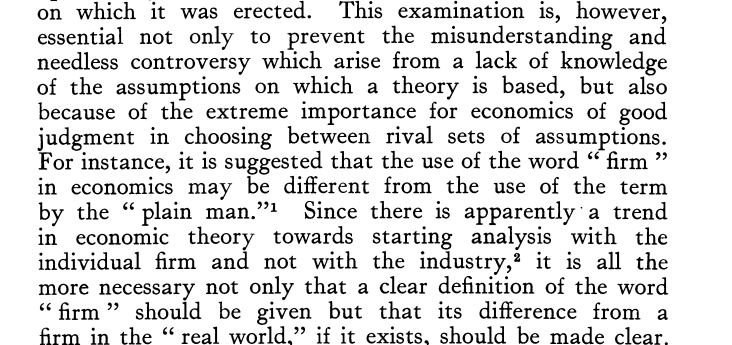
This is not good because it leads to needless controversy about the set of foundations, but also because it stops us from choosing the right set of assumptions. The colloquial definition of "firm" and the economic definition of "firm" are very different.

As economists have increasingly gravitated to studying economics through the firm--and not by an industry--we must not only define what "firm" means in economics and how it differs from the colloquial meaning of a "firm", if there is any. But not any mere definition will do.Image
Image
Apr 15, 2025 26 tweets 7 min read
@nullmalimnockin @F22_Raptor_0 Bueno, esto es más un juicio filosófico sobre qué modo de producción era la China maoísta que un análisis de la China maoísta en sí misma. Pero supongo que podemos ser algo generales: 🧵 @nullmalimnockin @F22_Raptor_0 En primer lugar, la idea de modo de producción es muy controvertida. Si el modo de producción se refiere a quién controla las fábricas, los bienes de capital, etc. y el socialismo es cuando los trabajadores lo controlan, entonces claro, la China maoísta nunca fue "socialista",
Mar 17, 2025 11 tweets 3 min read
? Foucault was critical of the idea men expressed Gattungswesen (self-expression, individual expression) and structuralist thought (alth. he wasn't a post-structuralist) and he views power as the agglomerated sum of individual relations,

very different to Marx's structuralist 'relations to production' being deterministic of social structures... Foucault rejected both a Marxist and poststructuralist label because of this... (1/n) Konkin says the state is a particular group whom influence relations top-down but individuals still organise in ways that subvert it (counter-economizing) so class is not just a particular group of actors being privileged, although the political capitalist group roughly fits that label (2/n)
Nov 19, 2024 11 tweets 2 min read
very much agreed.

institutional frameworks to an extent shape people. strong and efficient institutions not only bring prosperity but also instill virtues, discourage free-loading, violence, etc. all of which bring instability and with the desecration of private property a chaotic state of reduced production, companies moving out, and ultimately more poverty. permissible theft, especially easily permissible theft means freeloading is implicitly encouraged which not only means the business loses money, and eventually accrues
Nov 12, 2024 11 tweets 2 min read
Yes, capitalism is unnatural in that animals aren't entrepreneurs and they can cooperate.

But animals do compete with each other, animals try to maximize "profits" (food), and animals have semblances of property. So they are partly 'capitalist'.

In reality, both cooperation and competition exist naturally, and both cooperation and competition exists in capitalist economies.

Of course, debt and rent and the like are indeed unnatural. But unlike animals, which desire specific goods, using particular methods, almost like a robot,
Nov 12, 2024 35 tweets 5 min read
Ich stimme dem bis zu einem gewissen Grad zu. Der Kapitalismus ist weder gleich noch unterstützt er „Rechte“, denn erstens ist er nur ein System, das sich nicht verpflichtet fühlt, auf eine bestimmte Art und Weise zu handeln, und zweitens gibt es diejenigen, die vom Austausch mehr profitieren als andere. Dies ist jedoch nicht unbedingt ein Argument gegen den Kapitalismus, sondern eher ein Argument gegen die Torheit derjenigen, die an positive Ansprüche und „Bürgerrechte“ glauben. Bürgerrechte sind in einem Vakuum nutzlos und haben keine Gültigkeit
Nov 11, 2024 7 tweets 1 min read
@UrbaniteShitlib It depends what you mean by socialism. The term has been co-opted by so many movements and has been used to describe so manay idealized views of society it's practically an anti-concept. Even things that seem "socialist" like the labour theory of value, abolishing money, @UrbaniteShitlib abolishing property, abolishing class, and etc, aren't universally held. So it's really incoherent because 'socialists' have no clear-cut agreement on what delineates socialism. Unlike the capitalists, who at least agree that such a system entails
Nov 9, 2024 34 tweets 6 min read
@benny_eks This person is right when they say Mao's policies is not 100% responsible for the GLF's failures, after all weather is a factor.

However, part of an effective policy is one that accounts for such conditions. A system is after all intended to serve the material constraints (+) @benny_eks of which weather is a factor. If you continue pushing a specific type of agricultural production policy with the full knowledge that there are many terrible geographical conditions, like rivers like the Yangtze and the Yellow River periodically flooding, or
Nov 8, 2024 13 tweets 2 min read
At the core of solarpunk is contraditions; they posit that growth and progress is needed unless the degrowthers. This is a positive step. Progress after all is predicated on growth. But in a post-capitalist world too much growth would be seen as decadent and hazardous thus at a point technological innovations would have to stop or you're reinventing capitalism. Also, investment for capitalintense infrastructure requires large hierarchies with actors taking on low time-preference, long-run actions. Otherwise, the real opportunity